Heavy paper flowers can look weightless while placing real strain on a ceiling, wall, or freestanding frame. The right hanging tools depend on the installation’s total weight, its shape, and the surface supporting it. What tools are needed to hang heavy paper floral installations? Common options include a reliable scale, a stud finder, rated anchors or clamps, suitable suspension line, carabiners, and a level. Each choice needs to match the site and the load.
Botanical artist and paper-flower author Tiffanie Turner offers useful craft context, but I can’t verify a quotation from her about hanging heavy installations. Rather than inventing one, this guide uses a practical working principle: “A beautiful installation still needs a dependable load path.” Check venue rules and hardware ratings before installing. Never assume that decorative hooks or thin fishing line can support a large arrangement.
A small test build helps reveal weak points. Hang a sample from the planned support, then inspect its movement and attachment points. Distribute weight across several approved supports when the design allows. Keep spare fasteners and a second person nearby. Even careful plans can miss a detail. That is worth admitting—and checking.
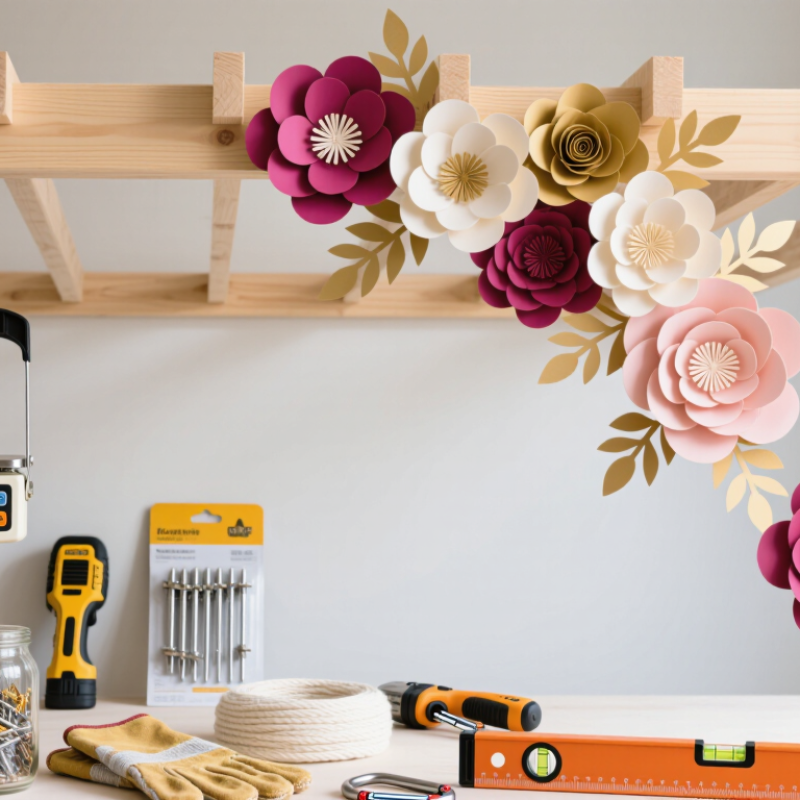
Paper flowers may look weightless, but a large installation can become surprisingly heavy. The total load includes the paper, stems, backing panel, wire, and any lights or ornaments. Measure the finished piece with a luggage scale before choosing hardware. A rough estimate is better than guessing, though it can still miss uneven weight.
Structure matters as much as weight. A dense cluster near one corner can pull a panel sideways, even when the overall load seems modest. Attach flowers to a rigid backing, then connect that backing to more than one secure support point. Use a stud finder on drywall, or select anchors rated for the wall material and expected load.
Leave a safety margin. Paper also catches air, so a lightweight display near a doorway may shift when people pass. Check every connection, then gently test the installation before adding the full arrangement.
I would not trust a single hook just because it held a small sample. That assumption is easy to make, and easy to regret.
Keep the heaviest flowers close to the support points, and inspect the structure after hanging; paper can soften or sag over time.
Heavy paper flowers look light, but a wide cluster can put real strain on one hanging point. Match the anchor to the surface, not just the paper décor’s weight. Include frames, wire, and any support bar when estimating the total load. Leave a safety margin. A stud finder helps locate framing behind drywall; use a properly sized screw eye or hook there. Without a stud, select a hollow-wall anchor with a published capacity above the full load. Check the rating.
For timber beams, predrill a pilot hole before fitting an eye screw to reduce splitting. Masonry needs a masonry bit and a compatible expansion anchor; avoid placing heavy loads in weak mortar. A ceiling grid is not a structural support. Attach to the building structure above it, using rated wire or cable and secure connectors. One detail is easy to overlook: the connector may be the weakest part, even when the anchor is strong.
Use a level, measuring tape, and stable ladder to keep the installation balanced. A spreader bar can distribute several flower clusters across multiple support points. Test the setup gradually, and have another person steady the ladder and watch for shifting. Ratings can be confusing, and a careful estimate can still miss hidden damage. If the surface is cracked, hollow, or unfamiliar, pause and ask a qualified installer to assess it.
Heavy paper floral installations need support chosen for the ceiling, not just the decoration’s weight. Mounting hardware works well when its anchors match the actual surface: a solid timber joist, masonry, and a suspended ceiling require different solutions. Check the hardware’s rated capacity and include the frame, ties, and any fabric in the load estimate. Paper looks light. A large cluster can still pull unevenly.
Cables offer cleaner spans and adjustable positioning, especially when several flower clusters hang at different heights. Use compatible, load-rated cable, connectors, and attachment points; avoid sharp bends that could weaken or damage the line. A cable may look taut while still shifting under movement. Test the arrangement at a low height, then inspect every connection. Small details count.
Rigging tools help installers tension, measure, and secure the system, but tools do not replace a sound plan. A level, measuring tape, and suitable tensioning equipment can reduce sag and keep spacing consistent. For overhead installations, have a qualified person assess the structure and setup. Paper petals catch air from doors and vents, so allow for movement. I would not assume a neat first test proves the final layout is safe.
Before lifting a heavy paper floral display, measure its width, depth, and finished weight. Mark the installation points, then use a stud finder to locate framing behind the wall or ceiling. Choose fasteners rated for the surface and expected load; a decorative hook is not automatically a structural support. For plasterboard, use a suitable rated anchor only when framing is unavailable and the load permits it. Never suspend a heavy arrangement from paper, tape, or an unverified ceiling fitting. Wear eye protection. Keep the work area clear.
Attach the support hardware with a drill, then check alignment with a level before adding flowers. Build the display in manageable sections, securing each section to the frame rather than to neighboring paper petals. For ceiling installations or uncertain load paths, ask a qualified installer to assess the fixing points. Lift with another person, and use a stable platform instead of reaching from a chair. Gently test the support before decorating, then inspect every connection once the full piece is in place. A slight sag can be easy to miss at first. It is worth pausing here; rushing this step often means taking the display down and fixing it again.
Suggested quantities for a single-person installation of an approximately 2 m-wide display. Actual fasteners depend on the display’s weight and the wall material.
Step-by-step: Measure and mark the layout, locate suitable structural support, install appropriately rated mounting hardware, attach the support structure, then secure the paper flowers with temporary clips while arranging them. Check that the finished display is stable. For masonry or other non-stud walls, select anchors rated for the surface and load.
Heavy paper flowers look weightless, but a dense cluster can strain its supports. Check the weight of the complete installation, including frames, wiring, and attachments. Compare it with the rated capacity of every component, not just the hook. The lowest rating sets the limit. Keep a generous safety margin, and follow the manufacturer’s instructions.
The ceiling or wall matters too. A strong fastener in weak plaster is still a weak support. Identify the underlying structure, choose compatible anchors, and ask a qualified installer when the substrate is uncertain. I have seen careful layouts overlook a small connection point; it is easy to miss. Avoid hanging decorations above busy areas when a safer location is available. Where the system allows, use an independent secondary support.
Tips: Weigh the finished piece before lifting it. Inspect knots, clips, and attachment points for wear or looseness. Recheck them after installation and whenever the display is moved. Keep a clear area below during setup. If anything shifts, sags, or makes a new sound, lower the piece and reassess rather than tightening it blindly.
Weigh the finished piece with a luggage scale. Include the paper, stems, backing, wire, lights, and ornaments. Guessing can miss uneven weight.
A dense corner can pull the backing sideways, even when the total load seems modest. Keep heavier flowers near support points. Paper can sag over time.
Attach them to a rigid backing panel. Connect the panel to more than one secure support point. One hook may not be enough.
Match anchors to the actual surface, such as a timber joist, masonry, or drywall. Check each component’s rated capacity. The lowest rating sets the limit.
Cables can create clean spans and adjustable heights for several clusters. Use compatible, load-rated cables and connectors. Avoid sharp bends.
Test it at a low height and inspect every connection. A neat first test can still be misleading. Ask a qualified person to assess uncertain structures.
Check knots, clips, and attachment points for looseness or wear. Recheck after moving the display. Small details count.
Lower it and reassess the supports. Do not tighten parts blindly. Keep the area below clear during setup.
This guide explains how to choose reliable tools for hanging heavy paper floral installations, starting with an assessment of the display’s weight, dimensions, and structural layout. It covers how wall, ceiling, and other mounting surfaces affect the choice of anchors and supports, and compares practical options such as mounting hardware, suspension cables, and rigging tools. The goal is to match each component to the installation’s needs rather than relying on appearance alone. What tools are needed to hang heavy paper floral installations? The answer depends on the surface, the arrangement’s construction, and its total load.
A step-by-step approach shows how to attach supports, distribute weight, and secure the floral display while minimizing stress on individual connection points. The guide also emphasizes checking the rated load limits of all hardware, allowing for the weight of the complete arrangement, and inspecting connections after installation. Regular checks help identify loosening or wear early, keeping the display stable throughout its time on view.

Arden Decor